
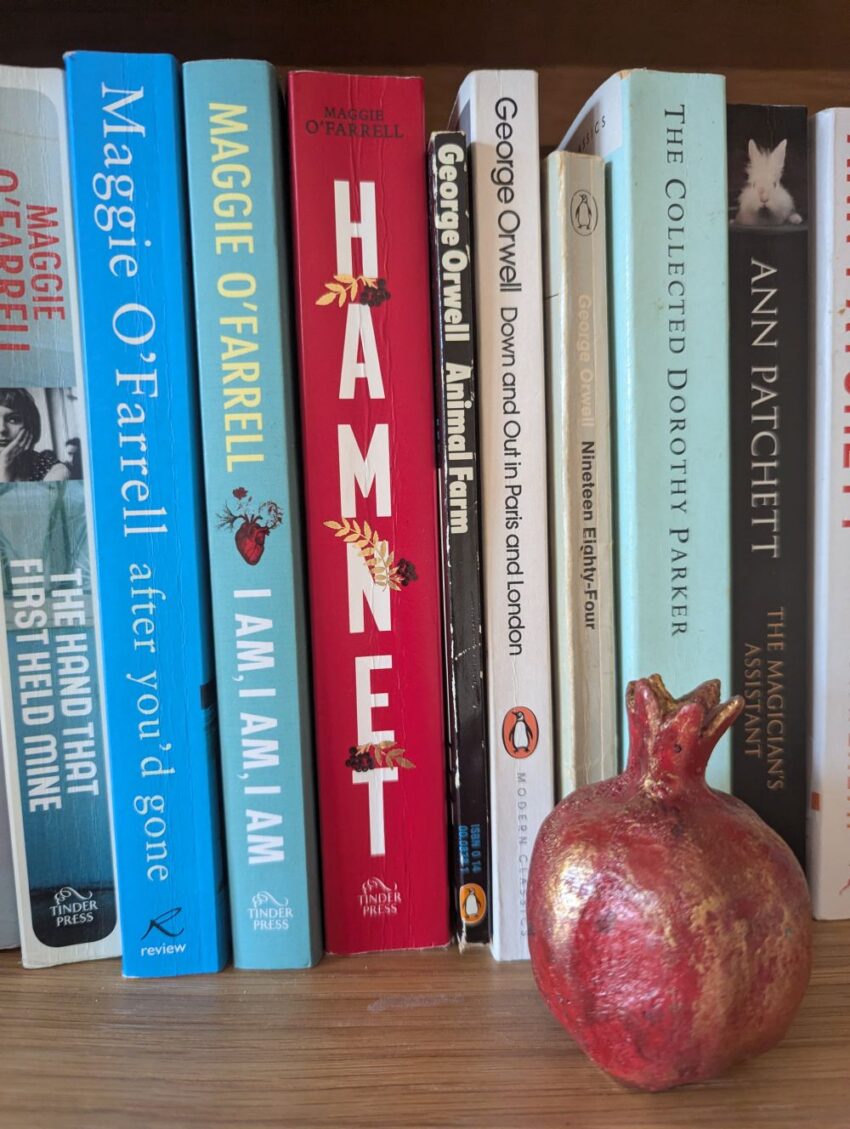
I have just been to see the film Hamnet. I thought Maggie O’Farrell’s novel was wonderful and, judging by its 2 million copies sold worldwide, I wasn’t the only one. It’s always a challenge to make a film from a book that people have loved so much, and there’s usually some griping. We know, of course, that a book can never be adapted completely faithfully: a novel isn’t a screenplay, and changes and adjustments need to be made. Sometimes authors actively dislike the film adaptations of their novels (for instance, PL Travers detested the Disneyfication of Mary Poppins), but Maggie O’Farrell co-wrote the screenplay with the director and seems pretty pleased with the result.
I also loved the film, as did many others. In fact, Jessie Buckley has just received a Golden Globe award and an Oscar nomination for her role as Agnes, Shakespeare’s wife. I thought that both she and Paul Mescal gave wonderfully moving performances as parents grieving over the loss of their son. Many of the film’s reviews have been glowing, but some have been truly scathing. One critic referred to it as ‘grief porn’, but surely that would fairly describe all of Shakespeare’s tragedies. The body count by the end of Titus Andronicus reaches an impressive fourteen. King Lear racks up ten.

However, opinions vary and I suppose it’s the reviewer’s job is to cast a critical eye over what they see. The criticism that does annoy me though is one of historical or logistical inaccuracy. I don’t care if the beams of the houses are black rather than brown, I don’t care if no-one really knows the cause of Hamnet’s death and I don’t care if Shakespeare actually wrote Hamlet before his son died. This film is based on a work of fiction – it isn’t a documentary. Maggie O’Farrell didn’t claim that her book was a factual account of Hamnet’s life and death, and of his parents’ relationship. It’s called artistic imagination.
This happens a lot. Experts and non-experts seem to enjoy poring over films and television programmes, pouncing on any minor inaccuracy, real or imagined. I suppose it’s a reflection of the pedant in us all – an unappealing trait I always think. Apparently, people take issue with the inaccuracies in James Cameron’s epic film Titanic. Really? It’s not a documentary? Someone should have told us.
I now know (and half-wish I didn’t) that when Kate Winslet (as Rose) is lying on a piece of driftwood in the ocean, the night sky is astronomically incorrect. When an astrophysicist informed James Cameron of his night sky slip-up, he went on to correct it in the 3-D version. I don’t think I’d have bothered myself, but I think he must be quite sensitive to criticism. In fact, so many disgruntled fans complained that Kate Winslet should really have moved over and shared her bit of wood with poor doomed Leonardo DiCaprio, that James Cameron actually commissioned a study to look into the matter. The conclusion was that the extra weight would have caused it to sink. Sigh.
I think we all need to relax a bit. Sit back and enjoy wonderful films without putting them under a microscope, searching for historical and scientific inaccuracies. I know that Mary Poppins, my favourite film from childhood, certainly wouldn’t stand up to scrutiny of any sort. Especially by its author.